Core Technology · 01 Carbon Conversion
Industrial By-products + CO₂
→ High-Value Calcium Carbonate
C-PCC (CO₂-converted precipitated calcium carbonate) is a circular CCUS technology that uses landfilled industrial by-products as its main feedstock and converts CO₂ in flue gas to produce high-purity calcium carbonate and construction materials.
Concept
C-PCC Technology Concept
Using CO₂ in flue gas together with industrial by-products, it aims to achieve four things at once: ① recycling by-products ② cutting CO₂ ③ producing high-purity calcium carbonate ④ using process residue as construction materials.
Detailed process conditions and equipment configuration are protected by patents and trade secrets, and are explained after signing a non-disclosure agreement (NDA) when reviewing a partnership. The residue path is designed towards zero waste, and each application requires demonstration.
Differentiation
How it differs from conventional PCC
| Item | Conventional PCC | C-PCC (CARBON-U) |
|---|---|---|
| Feedstock | Natural limestone calcined above 900°C (CaCO₃ → CaO + CO₂) and then re-carbonated — it only returns the calcination CO₂, so there is no net reduction | Industrial by-products (steel slag, etc.) — upcycling landfill-bound material as the main feedstock |
| CO₂ | CO₂ emitted during calcination | Converts CO₂ · about 44% of C-PCC by weight is converted CO₂ (CaCO₃ stoichiometry) |
| CO₂ capture | — | No separate CO₂ capture equipment · applicable to sources with 1%–100% CO₂ concentration (process feature) |
| Water · residue | Unsustainable feedstock | Process water reused · residue used as construction feedstock |
| Regulatory fit | Disadvantaged under environmental regulation | Designed for emissions trading · registration of external GHG methodology and Green Technology Certification in progress |
| Product | CaCO₃ | High-purity calcium carbonate + construction materials (two product groups) |
※ “44%” is the mass share of CO₂ (MW 44) in calcium carbonate (CaCO₃, MW 100); it is not the net reduction of the whole process (LCA). Net reduction will be published after the LCA methodology is fixed.
Types of calcium carbonate — GCC · PCC · C-PCC
| Item | GCC (ground) | PCC (precipitated) | C-PCC |
|---|---|---|---|
| Production | Natural limestone ground mechanically | Limestone calcined → Ca(OH)₂ + CO₂ precipitation | Calcium from by-products + flue-gas CO₂ conversion |
| HS CODE | 2517.49 | 2836.50 | 2836.50 (precipitated calcium carbonate) |
| Particles | A few μm to hundreds of μm, irregular | Tens of nm to a few μm, controlled crystal form | Particle size and crystal form tailored to customer needs |
| Specific surface area | Low (about 1 ㎡/g) | High (5–87 ㎡/g) | Controlled for each application |
| Whiteness | Relatively low | 95~100 | 97 (KTR test) |
| CO₂ | Mining and transport emissions | Calcination fuel and process emissions | Flue-gas CO₂ fixed in the product |
GHG Reduction
CO₂ emissions per tonne of calcium carbonate
To make the same tonne of calcium carbonate, limestone-based products emit CO₂, while C-PCC absorbs CO₂ across the whole process.
| Per tonne of calcium carbonate (kg CO₂) | GCC | PCC (anthracite) | PCC (LNG) | C-PCC |
|---|---|---|---|---|
| Net emissions from manufacturing | 150 ~ 250 | 590 ~ 690 | 370 ~ 470 | −390 ~ −340 |
※ Company estimates (excluding sales transport and electricity use). This is not a third-party-verified LCA; registration of an external GHG-reduction methodology is under way.
Quality · Accredited Tests
C-PCC quality confirmed by accredited tests
Products from the Ulsan C-PCC plant were tested by KTR (Korea Testing & Research Institute) in Nov–Dec 2024.
Purity 99.9%
Content (CaCO₃) · KS M ISO 6353-3
Whiteness 97
Hunter whiteness · KS L 5113
Six heavy metals not detected
Lead · arsenic · mercury · cyanide · hexavalent chromium · cadmium (NIER official test methods)
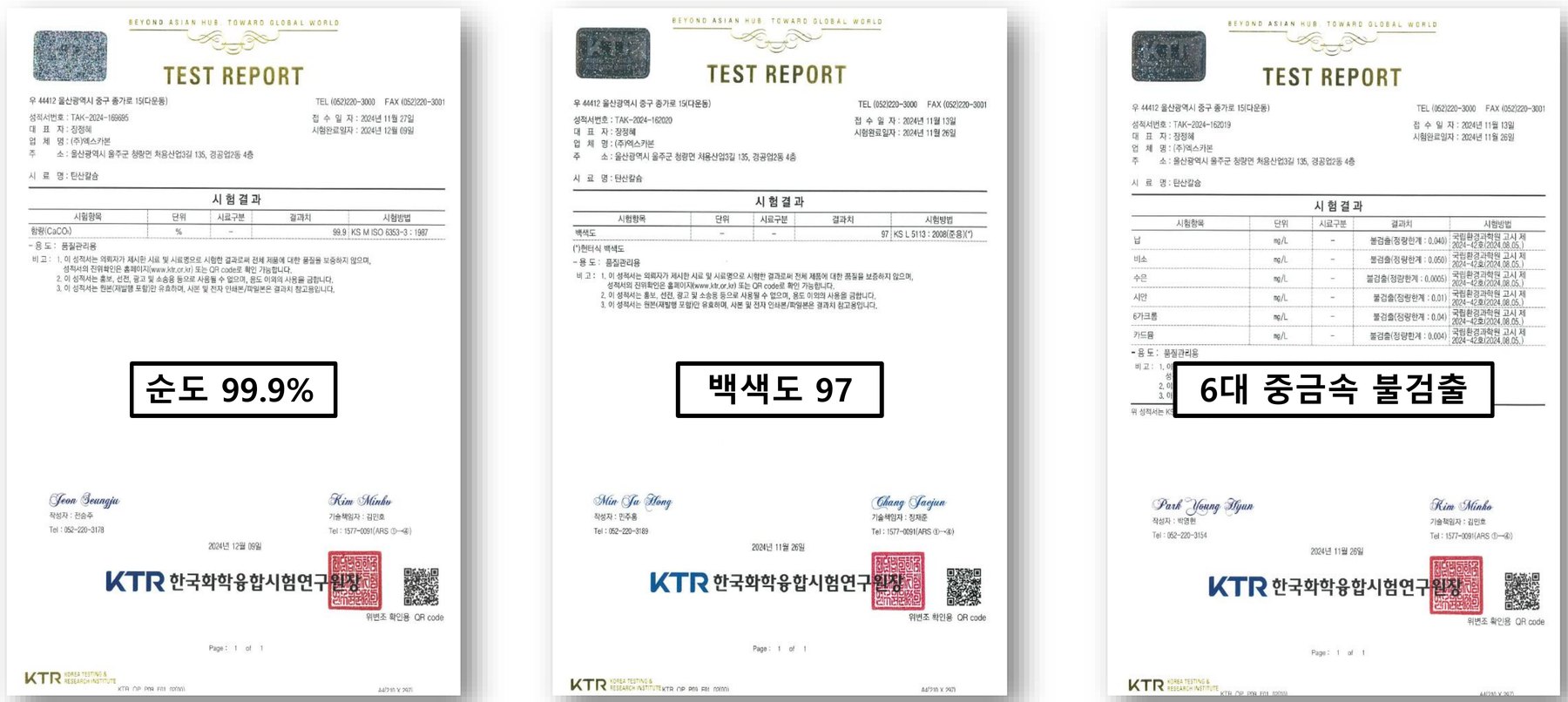
Particle size and crystal form can be tailored to customer requirements. The process target spec is purity ≥ 95% and whiteness ≥ 95.
Bio C-PCC
Calcium carbonate made from biogenic CO₂ —
84% bio-based carbon
C-PCC made with CO₂ from biomass-derived emission sources has mostly bio-derived carbon. It can be used as a bio-based material distinct from calcium carbonate made with limestone- or fossil-derived carbon.
| Sample | Bio-based carbon content |
|---|---|
| Calcium carbonate made with bio CO₂ (C-PCC) | 84% |
| Calcium carbonate from limestone (GCC) | 2% |
| Conventional PCC product | 0% |
| Calcium carbonate from purchased industrial CO₂ | 1% |
Korea Apparel Testing & Research Institute (KATRI) test report, 2023.07 · ASTM D6866-22 Method B (AMS).
Feedstock
By-products C-PCC uses
Feedstock in the Regulation-Free Special Zone demonstration
Cement-process by-product
2024 National Quality Innovation Competition — Gold Prize (NPD)
Power-generation · incineration by-product
30 million+ t/yr · registered patent No. 10-2444775
Steel slag generation is 12 million t/yr; CBS dust landfill cost is KRW 350,000–500,000/t (2024). Reports say waste treatment prices rose from about KRW 110,000/t in 2016 to KRW 240,000/t in 2020 — which is why large-scale by-product recycling technology is needed.
Applications
Applications
Calcium carbonate for filling and coating
PVC artificial leather fabric
Filler for plastic compounds
Reinforcing and extending filler
Automotive interior suppliers · SMC materials — used in place of conventional calcium carbonate
Application under review in footwear material supply chains
We are expanding demonstration cases into shipbuilding, road paving and cement, and have also developed a white-pigment substitute material.
Target spec (high-purity calcium carbonate): purity ≥ 95% · whiteness ≥ 95 · adjustable particle size
Proof
Already proven
- 5 t/day C-PCC commercial technology verified through the CO₂ Regulation-Free Special Zone demonstration — capabilities in designing, building and operating production equipment
- Development of mass-production technology for C-PCC from cement-process by-products
- Aiming for circularity by reusing process water and turning residue into construction materials
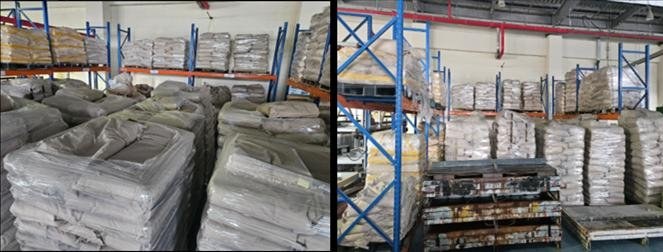
Your by-products can become materials
We review the upcycling potential of alkaline by-products and CO₂ from your site together.