Carbon Mineralization & CO₂ Storage
CO₂ Utilization → Mineralization
→ CO₂ Storage
Starting from technology that fixes CO₂ in calcium carbonate, we expand step by step to carbon mineralization using process residue and to onshore CO₂ storage in abandoned mine voids.
Stepwise Expansion
Three steps, different maturity
CO₂ utilization and CO₂ storage are different businesses. CARBON-U separates the two and clearly shows where each step stands.
STEP 1 · CO₂ Utilization
Calcium extracted from industrial by-products fixes CO₂ in calcium carbonate (C-PCC) — CCU sold as a product.
C-PCC →STEP 2 · Carbon Mineralization
Process residue left after calcium recovery is reacted with CO₂ and stabilized as minerals — used as construction and fill materials.
STEP 3 · CO₂ Storage
Onshore storage that fills abandoned mines with residue and injects and mineralizes CO₂. Commercialization is under review with a 2031 business target.
Why Mineral Carbonation
Why we chose mineral carbonation among CCU technologies
Chemical and biological conversion need high-concentration CO₂ to be captured first. Mineral carbonation reacts CO₂ with alkaline earth metals such as Ca, Mg and Na to form carbonates, so large volumes of CO₂ can be treated without a separate capture step.
| Item | Chemical conversion | Biological conversion | Mineral carbonation (C-PCC) |
|---|---|---|---|
| Process | Reacts CO₂ with hydrogen etc. into chemicals such as methanol and urea | Microbes and algae absorb CO₂ into biomass, fermented into fuels | Calcium from industrial by-products reacts with CO₂ and is fixed as CaCO₃ |
| Reaction conditions | High temperature (200–300°C) · high pressure · metal catalysts | Ambient temperature and pressure, photosynthetic or anaerobic conditions | CARBON-U proprietary process (detailed conditions not disclosed) |
| CO₂ reduction effect | Low — almost none when fossil-based hydrogen is used | Low to medium — some CO₂ re-emitted during fermentation and decomposition | High — fixed as solid carbonate (carbon removal) |
| Economics | Costly equipment, catalysts and hydrogen; green hydrogen required | Low conversion efficiency, large land and water needs | Lower waste treatment costs, high-purity CaCO₃ sales, residue recycled into construction materials |
| Applications | Industries that can supply high-concentration CO₂ and hydrogen | Low-concentration CO₂ emitters (agriculture, environment) | Industries that generate by-products — steel, power, cement |
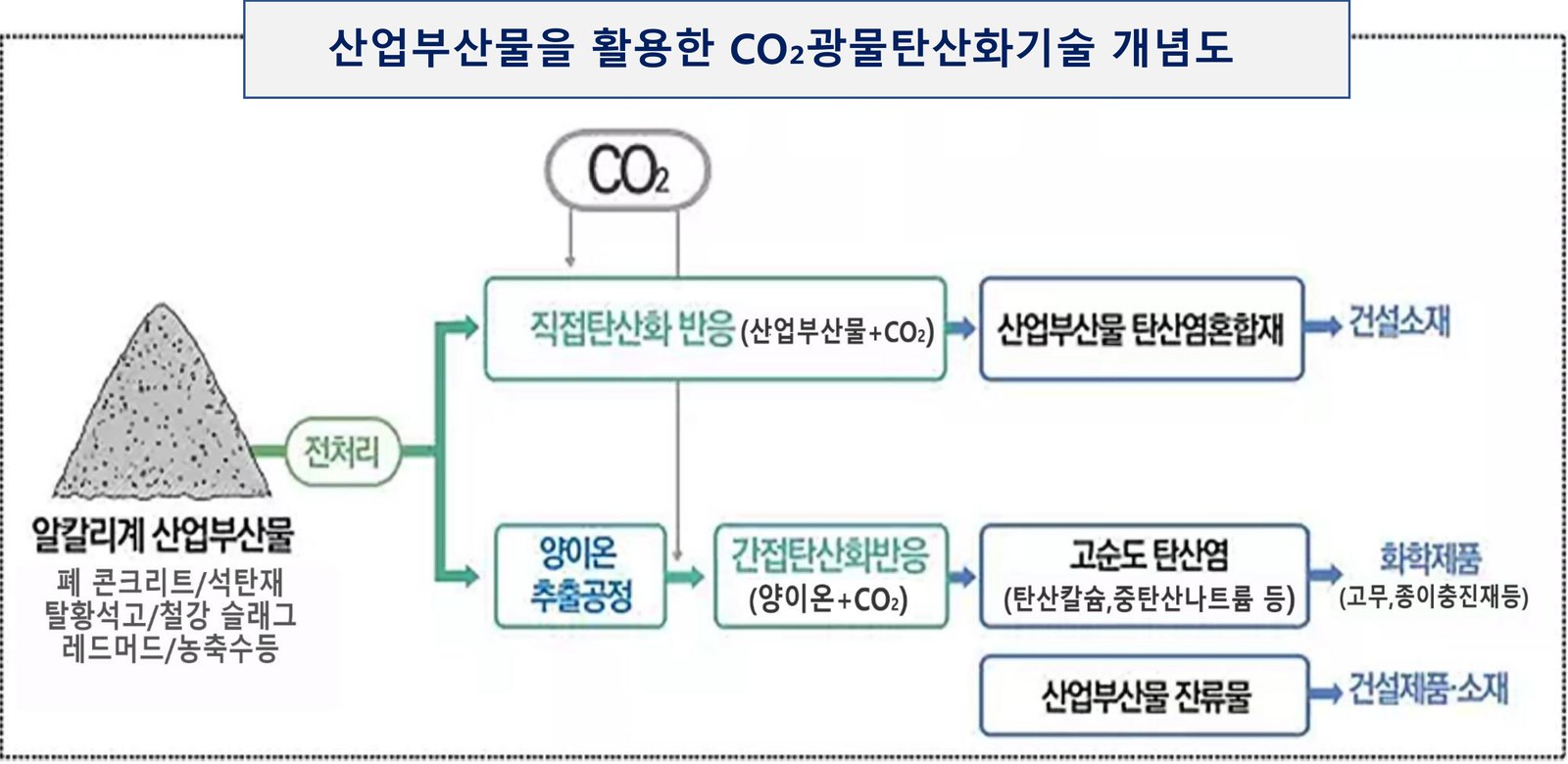
Direct vs Indirect
C-PCC is Ca-based indirect carbonation
Indirect carbonation
Calcium is first recovered from industrial by-products and then reacted with CO₂ to make high-purity carbonate.
- Strength: additional revenue from calcium carbonate sales
- Challenge: higher process cost than direct carbonation
Direct carbonation
Feedstock reacts directly with CO₂ to form carbonates — low-purity calcium carbonate · ground fill.
- Strength: low process cost
- Challenge: limited uses, lower CO₂ storage
- Calcium (Ca)-based — aiming to produce high-grade calcium carbonate even from low-grade industrial by-products
- The final CaCO₃ stores CO₂ in a very stable solid form
Korea's CCUS Act (Act on CO₂ Capture, Transport, Storage and Utilization) in force since Feb 7, 2025
It unifies CCUS rules once scattered across some 40 laws. It sets out onshore and offshore storage site selection, storage permits and monitoring, together with certification of CO₂-utilization companies, technology and product certification, demonstration and commercialization support, and grants and loans. Abroad, the EU Carbon Border Adjustment Mechanism (CBAM) takes effect in 2026. K-GX policy fit →
Carbon Mineralization
Process residue is not waste,
it is a functional filler
Residue left after recovering calcium from industrial by-products may become a functional fill material for stabilizing mine voids and fixing additional CO₂.
The actual CO₂ reaction varies greatly with the feedstock composition, so demonstration tests are required. CARBON-U does not assert this figure before demonstration.
CO₂ Storage · Future Business
Abandoned mine → residue filling → CO₂ injection
→ mineralization
Onshore CO₂ storage tends to have lower initial and operating costs than offshore storage, but in Korea — small and densely populated — securing large storage sites and public acceptance are challenges. CARBON-U plans, as a future business, a circular storage model that uses existing abandoned mines and combines residue filling with carbon mineralization.
Future Business · 2031 targetRecovering useful resources from by-products to make products
Reusing residue as mine-void filler instead of disposing of it
Preventing subsidence and improving mine environments
Additional carbon reduction when combined with CO₂ mineralization
Technology Insight · Publication
“Trends in CO₂ Mineralization and Onshore Geological Storage”
CEO Ha Seong Jang of CARBONU Co., Ltd. · KOMIR (Korea Mine Rehabilitation and Mineral Resources Corporation) “Technology & World” Vol. 5. It covers CCUS trends, CCU vs. CCS, ocean and onshore storage, and a circular-economy model based on construction materials, industrial by-products and mine voids.
CO₂ utilization · storage partnership
We propose joint demonstrations with CO₂ emitters, mine and ground-related agencies, and research institutes.